Introduction
Released nearly a year apart, the Sony Xperia S and the Samsung Galaxy S II are not that different - both are flagship droids with dual-core CPUs and 4.3" screens. But the newer Xperia S brings some fine upgrades, like the 12MP camera and the 720p screen.
Still, the Galaxy S II is the outgoing Samsung flagship while the Xperia S is the best and the brightest of Sony's new NXT series and will be for a while longer, so it will have to fight off the onslaught of quad-core droids headed to market.
Processor aside, the Sony Xperia S brings a high-pixel-density 4.3" screen with 720p resolution and Mobile BRAVIA engine. Then there's the 12MP camera with 1080p video recording, a notable advantage as most new recently announced phones use 8MP shooters. There's also excellent connectivity and so on.
The 1.5GHz dual-core CPU and Adreno 220 GPU showed promising performance, beating most dual-cores too. Here's the summary of the pros and cons of going for the Sony Xperia S.
Sony Xperia S over Samsung Galaxy S II:
- 4.3" 720p screen (342ppi) over 4.3" WVGA screen (217ppi)
- 12MP still camera over 8MP
- 1.5GHz Scorpion CPU over 1.2GHz Cortex-A9 CPU
- Standard microHDMI port over MHL port (requires adapter for HDMI out)
- GLONASS support in addition to A-GPS
- All units have NFC over optional support in the S II
- 1750mAh battery over 1650mAh
- 3D sweep panorama and Multi Angle modes
Samsung Galaxy S II over Sony Xperia S:
- SuperAMOLED Plus screen has excellent black levels and better viewing angles
- Expandable storage, 16GB/32GB built-in over 32GB fixed storage
- 8.5mm thick (with some thicker areas) over 10.6mm (with thinner areas)
- Weighs 116g over 144g
- Bluetooth 3.0+HS over Bluetooth 2.1
- 2MP front-facing camera over 1.3MP front-facing camera
Both phones have features that we wish the other had, so there's no clear winner. Also, we'll be doing thorough testing too match the performance in seemingly equal areas (e.g. 1080p video capture) and also if the differences change the end user-experience (1.5GHz CPU vs. 1.2GHz, 1750mAh battery over 1650mAh and so on).
You should already be familiar with the structure of these head to head articles - we'll start off with a general comparison and then dig into the specifics, like screens, cameras, battery life and so on.
Software and hardware overview
The Sony Xperia S and the Samsung Galaxy S II both have 4.3" screens with roughly the same aspect ratio, so you'd be forgiven for thinking that both phones are about the same phones.
The Galaxy S is shorter, slightly wider and noticeably thinner than the newer phone, the Xperia S. The Sony's Human Curvature design means it's nearly the same thickness at the edges, it's much thicker for the most part of its body. It's also heavier than the Samsung.
Here are some specific measurements - the Sony Xperia S is 128 x 64 x 10.6 mm big and weighs 144 g. The Samsung Galaxy S II is 125.3 x 66.1 x 8.5 mm and 116 g.
The Xperia S has a fresh design with the illuminated transparent strip at the bottom, which help it to really stand out.
We'll cover the screens in a separate chapter, there are more general hardware differences to cover here. We'll just note that both have scratch-resistant glass covering the screens, the Galaxy relies on the popular Gorilla Glass, while the Xperia uses an undisclosed source.
Moving on to storage, the Xperia S comes with 32GB of built-in memory, but it's non-expandable. The Galaxy S II on the other hand comes in 16GB and 32GB varieties, but it does have a microSD card slot if you really need that much storage.
When speaking of card slots, it's worth noting that Samsung use the traditional SIM card format, while Sony have opted for the newer (but less common) microSIM.
There's a lot to be said about connectivity, so we'll give it its own chapter further down.
Both the Sony Xperia S and the Samsung Galaxy S II run Android 2.3 Gingerbread and both are behind the times. However, both are going to be updated to Android 4.0 Ice Cream Sandwich soon, so they'll have a chance to catch up.
They have different user interface customizations, with TouchWiz changing more (notification toggles, adding/deleting homescreens, etc.), while Sony staying closer to the vanilla Android experience.
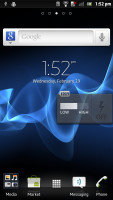
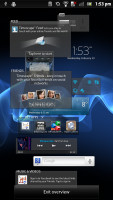

 The custom interface of Sony Xperia S • TouchWiz on Samsung Galaxy S II
Which one you prefer is up to you, but since you can easily change the launcher on Android that's not a big deal.
Both phones come with a number of apps out of the box, including several tools for social networking. They're powerful enough to run anything in the Google Play Store (the rebadged Android Market), so you can easily add to their functionality.
Screen comparison
The Sony Xperia S and the Samsung Galaxy S II have 4.3" screens but this is where the similarities ends.
The Galaxy S II uses a SuperaAMOLED Plus screen with 480x800 pixels resolution. It's characterized by deep blacks (zero light coming from black pixels), theoretically infinite contrast and excellent viewing angles. The pixel density of the screen is 217ppi.
The Xperia S has an LCD screen with a much higher resolution - 720x1280 or 2.4x the number of pixels. This pushes the pixel density to the whopping 342ppi, higher than even the iPhone 4 and 4S, which are largely responsible for the pixel density craze.
Anyway, the Xperia's screen has decent black levels (though the Xperia arc did a little better here. The Xperia S brightness is generally middle of the road but it's still about 50% brighter than the Galaxy S II. The contrast is over 1000:1, but is lower than the Xperia arc and the Galaxy S II screens.
Both screens have about the same reflectivity and they have very good sunlight legibility.
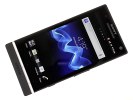
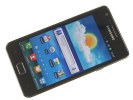 Sony Xperia S and Samsung Galaxy S II have excellent screens in their own right
Here's the table that compares the brightness and contrast of the Xperia S, Galaxy S II and other phones we've tested. Note that we couldn't get accurate measurements for the Xperia S screen at 50% brightness and they are not included in the table (Sony's software always adjusts the screen brightness according to the ambient light sensor, no matter what you do).
Still camera comparison
The Sony Xperia S and Samsung Galaxy S II cameras use fairly similar user interfaces - there is a still/video mode toggle, virtual shutter key and a gallery shortcut on the right of the viewfinder and a column of four customizable shortcuts on the left.
The customizable shortcuts are good because they let users tweak the camera to fit their particular needs - casual users will want things like scenes and effects there, while more advanced users can put manual controls there (like ISO, exposure compensation and so on).
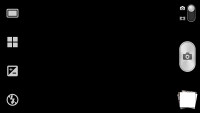
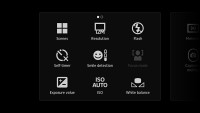 Sony Xperia S camera UI
The two phones do differ on one count - the Xperia S has a physical shutter key. It can also wake the phone if it's locked and there's even a setting to snap a photo right away.
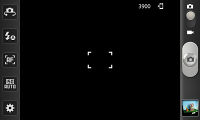
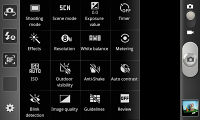 Samsung Galaxy S II camera UI
Then there's the camera resolution - the Sony Xperia S is one of the few 12MP shooters on the market, while the Samsung Galaxy S II has an 8MP camera. To compare them, we upscaled several S II photos to 12MP (to make the resolution comparison more fair) and prepared some crops.
We're also including the Nokia N8, one of the best cameraphone on the market (even if the phone attached to the camera hasn't aged that well).
You'll find untouched full-res shots from the phones at the end of this chapter if you want to do you own comparison.
Before we begin the image quality comparison, we have to point out the difference in field of view (FoV). The Nokia N8 camera is the widest, the Galaxy S II is nearly the same and the Sony Xperia S is the narrowest. Here's a chart that visualizes the difference.
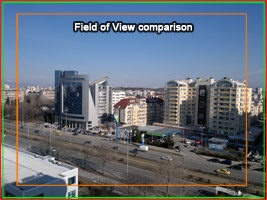 A Field of View comparison chart - Xperia S vs. Galaxy S II vs. N8
There's a tradeoff with different fields of view - wide-angle cameras fit more in the shot but a narrower FoV means that each object in view is composed of more pixels, so there's more detail in it.
Looking at a 12MP shot from the Xperia S and an 8MP shot from the Galaxy S II upscaled to 12MP, you see more fine detail in the Xperia S photos, just as you would expect.
The black on white text is crisper and so are the vertical bars of the railing. Even the 12MP Nokia N8 renders them softer.
A closer look reveals part of the reason - the Xperia S does quite a bit of sharpening to its photos, while Nokia has chosen to keep post-processing to a minimum. The Galaxy S II applies a lot of sharpening too.
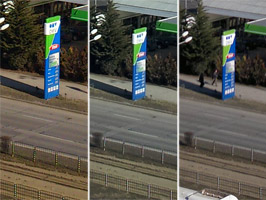
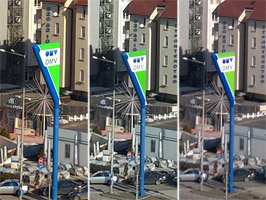 Sony Xperia S (12MP) vs. Samsung Galaxy S II (8MP upscaled to 12MP) vs. Nokia N8 (12MP)
The Sony Xperia S offers an accurate white balance, leaning towards yellow (typical consumer camera stuff). The colors are good though slightly oversaturated.
The Samsung Galaxy S II on the other hand tends to produce colder photos (they have a bluish tint) but it doesn't oversaturate colors. The Nokia N8 photos have neutral white balance and accurate colors.
The next crop has some blue sky and a good portion of it is in the shade, both of which are a very good indicators of the noise present in the photos. The Xperia S leaves some noticeable color noise in its photos - both in the sky and in the shade.
The Galaxy S II on the other hand does away with most of the noise at the cost of some sharpness - look at the Franck Muller label or the pole at the top of the building, it's nearly smudged into the background in the S II photo.
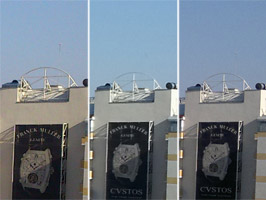 Sony Xperia S (12MP) vs. Samsung Galaxy S II (8MP upscaled to 12MP) vs. Nokia N8 (12MP)
Here's another crop that has rough wall texture - a fairly random texture with small details that noise reduction doesn't handle too well. And a lot of that texture is gone in the Galaxy S II photo (the lower resolution doesn't help here either), while it's rendered excellently in the Xperia S shot.
It's visible but less pronounced in the Nokia N8 photo, but a lot of that is due to the different exposure, contrast and the extra sharpening that the Xperia S does.
Look at the white window frames too - they're tinted in the Galaxy S II photo - but upon inspection in an image editing program you'll notice that the Xperia S overexposed the highlights (as seemingly Xperia phones like to do), while the Galaxy overexposed a much smaller portion of the window frames.
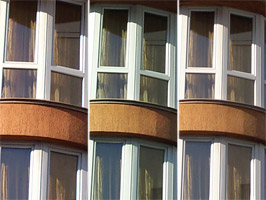 Sony Xperia S (12MP) vs. Samsung Galaxy S II (8MP upscaled to 12MP) vs. Nokia N8 (12MP)
As far as features go, the two cameras are evenly matched - they both have goodies like preset scenes, face detection and smile shot, image stabilization and geo-tagging. The Galaxy S II does feature blink detection too, while the Xperia S adds 3D to its panorama and then there's the Multi Angle view, which creates a sort of lentropic card effect, which we really like.
Both phones come equipped with single-LED flashes.
Also, they have front-facing cameras - the Samsung offers a 2MP camera (but can't record video), while the Sony shoots 1.3MP stills or 720p video.
Anyway, here are the full-res shots, as promised:


 Sony Xperia S • Samsung Galaxy S II • Nokia N8


 Sony Xperia S • Samsung Galaxy S II • Nokia N8


 Sony Xperia S • Samsung Galaxy S II • Nokia N8


 Sony Xperia S • Samsung Galaxy S II • Nokia N8



 Sony Xperia S • Samsung Galaxy S II